


Operational Transformation
Transform connected workflows. Change how the operation runs.
Forward Deployed Engineers and Experts work across the boundaries between teams, systems, and decisions to
create a stronger operating system for the business.









Operations do not break one workflow at a time.
The costly work often lives between functions: duplicated information, delayed decisions, manual reconciliation, and exceptions no system owns. Operational transformation connects those workflows around one coherent model instead of automating each problem in isolation.
From operating constraint to working system.
Move your operation from how it works today to how it should run tomorrow.
-
01 / ENTER
Work inside
the operation.Understand how work moves across functions, where context is lost, and which constraints matter economically.
-
02 / CONNECT
Redesign the
operating flow.Align related workflows, decisions, data, and human judgment around a shared operating outcome.
-
03 / SCALE
Build a system
that can expand.Prove the change in consequential workflows, then extend the model without relearning the operation each time.
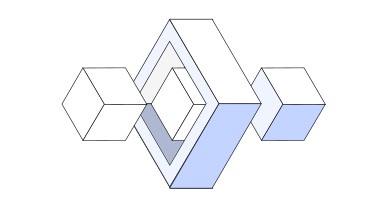
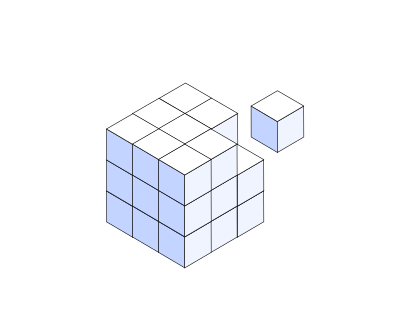

Operational judgment and engineering authority move together.
Forward Deployed Experts remain close to the people and decisions inside the operation. Forward Deployed Engineers build the software, automation, and integrations. Together they form one accountable delivery unit from redesign through production.

Multiple connected workflows

Shared operating context across each build

Forward Deployed Experts and Engineers paired as the core unit

Accountability through deployment, adoption, and operation
Questions, answered
How is Operational Transformation different from Workflow Transformation?
Workflow Transformation changes one consequential workflow. Operational Transformation addresses several connected workflows whose performance depends on shared teams, systems, data, decisions, or exceptions.
How do Forward Deployed Experts and Engineers work together?
Forward Deployed Experts remain close to the people, decisions, controls, and exceptions inside the operation. Forward Deployed Engineers translate that context into production software, automation, data flows, and integrations. They share responsibility for the operating outcome.
Can Creative Chaos operate some systems while we operate others?
Yes. Build and Operate decisions can be made around the responsibility, security, economics, and continuity needs of each system. The boundaries and handoffs must be explicit so operating accountability remains clear.
Will this replace our existing platforms?
Not by default. We first determine what the current platforms already do well, where the real workflow crosses their boundaries, and whether the better answer is integration, extension, replacement, or a new operating layer.
How do you decide where to begin?
We enter the operation, identify the constraints with the greatest economic and operational consequence, and select a starting workflow that can create value while establishing context for the connected work that follows.
Do all workflows need to change at once?
No. The operating model is designed across the connected workflows, but delivery can be sequenced. Each release should create a usable business outcome without closing off the architecture required for what comes next.
How do you measure whether the operation improved?
Measures are tied to the intended operating change: cost, cycle time, capacity, quality, risk, revenue, or decision speed. Acceptance criteria and ongoing performance measures are defined with the client before each system is deployed.
The operation has outgrown the workaround.
Show us where work slows between teams and systems. We will identify the right place to begin and the delivery unit required.