


 Ramsha Sadiq Khan
  Jun 25, 2026
  10 min read
 Share
Share

Search “best AI automation services,” and you will get pages of lists. Zapier. Make. n8n. UiPath. LangChain. Ten tools, ranked by features and pricing tiers.
Here is the problem. You were not looking for software. You were looking for someone to hire.
If you are a CEO, COO, or Managing Director at a 15- to 250-person company, you have probably already bought the tools on those lists. Your team has ChatGPT subscriptions. Someone set up a Zapier account. Maybe an agency built you a chatbot. And your operation runs exactly the way it did before.
The list answers the question “what software automates tasks.” Buyers are asking, “Who will make AI actually work inside my business?” Those are different questions. This article answers the second one: what the lists leave out, how to evaluate an actual AI automation service, what results to demand, and what it should cost.
The Short Answer
The best AI automation service is not a software platform. It is a person or firm that maps your operation, quantifies what manual work is costing you in dollars, builds the system that recovers that money, and stays accountable for a measurable outcome. Software is an ingredient in that process, not a substitute for it. Everything below explains how to tell the difference and what to look for.
What the “Best AI Automation Services” Lists Actually Rank
Look closely at the top-ranking content for this search term and three formats repeat:
Tool roundups.
“15 Best AI Automation Tools in 2026.” These rank software platforms by features, integrations, and pricing tiers. Useful if you have an in-house team ready to build. Useless if you do not, because a platform license does not map your processes or ship anything.
Agency directories.
Pay-to-play listings ranked by review volume, not results. These agencies sell deliverables: a chatbot, a workflow, a proof of concept. What they rarely sell is a dollar figure they are accountable for.
Body-shop comparisons.
Lists of firms renting developers by the hour. You get capacity. You do not get someone who decides what is worth building in the first place.
All three formats share the same blind spot. They rank inputs: tools, hours, and deliverables. None of them rank the only output that matters, which is verified business value. That is not an accident. Input-based content is easy to produce and easy to monetize with affiliate links. It just does not solve your problem.

Why the Lists Fail You: AI Has an Execution Problem
The gap between buying AI and benefiting from AI is now one of the best-documented findings in enterprise technology.
MIT’s Project NANDA found in its State of AI in Business 2025 report that 95% of enterprise generative AI pilots deliver no measurable impact on profit and loss, despite an estimated $30 to 40 billion in enterprise spend. The lead author’s diagnosis was not model quality. Tools stall in enterprise use because they do not adapt to how the business actually works, and nobody owns the path from pilot to production.
The same MIT research surfaced a second finding that should change how you buy: more than half of generative AI budgets go to sales and marketing tools, yet the biggest measured ROI came from back-office automation. Companies are spending where AI is most visible, not where it is most valuable.
Accenture’s findings point in the same direction. Its Front-Runners’ Guide to Scaling AI, based on a survey of 2,000 C-suite and data science executives, found that only 8% of companies have successfully scaled strategic AI initiatives across their operations. The other 92% remain stuck at experiments.
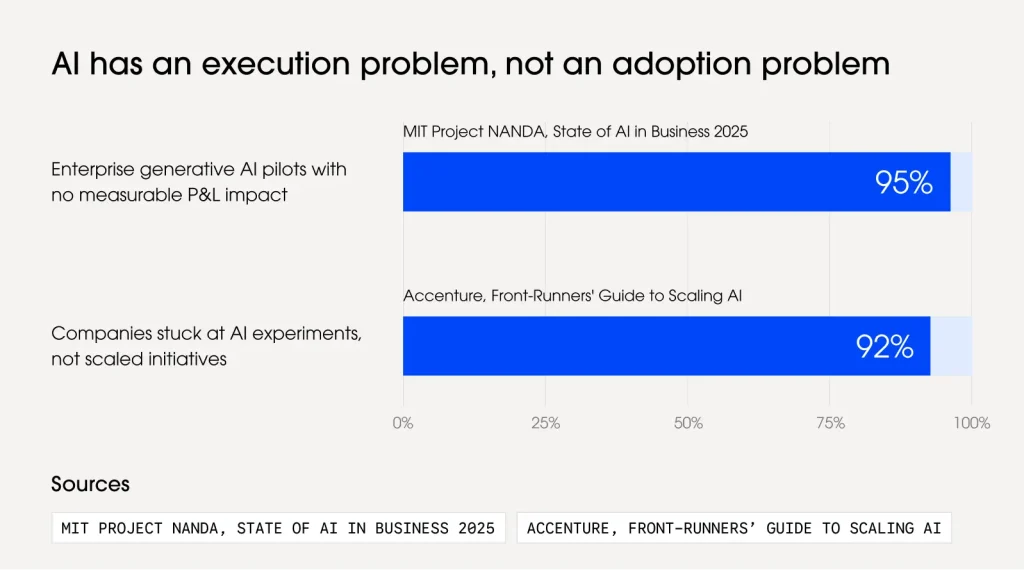
Read those numbers together, and the conclusion is hard to avoid. Most companies do not have an AI adoption problem. They have an implementation problem. Another platform subscription cannot fix it, because the missing piece is not software. It is a person with the judgment to find the right problem, the skill to build the fix, and the accountability to stay until it produces a number you can verify.
Software vs. Services: What You Are Actually Buying
| Dimension | AI automation software | A real AI automation service |
| What you get | A platform license | A working system in production |
| Who maps your processes | You | They do |
| Who builds and integrates | Your team or a contractor | The same person who did the diagnosis |
| Who maintains it | You | They do, optionally, with notice to stop |
| Pricing basis | Per seat, per task, per month | Should be tied to outcome value |
| Accountability | None beyond uptime | A dollar figure agreed before the build |
| When it fails | You troubleshoot | They are on the hook |
If a provider on any “best of” list cannot place itself cleanly in the right-hand column, it is selling software or hours wearing a services costume.
How to Evaluate an AI Automation Service: The Five Tests
1. They start with your operation, not their technology.
Most vendors begin with the tool they sell and look for places to apply it. The right partner begins with how work moves through your business: where time is wasted, where handoffs break, and which manual processes cost the most. The workflow determines the answer. Not the tool.
2. They implement, not advise.
You have probably seen the strategy deck before. Recommendations, a roadmap, an invoice, and then nothing. The deliverable should be working software running inside your operation, not a PDF describing software someone else might build later.
3. They quantify the value before the build.
If a provider cannot tell you what an automation is worth in dollars before building it, they are guessing. Every engagement should start with a number you both agree on, built from your own operational data.
4. You own everything.
Every line of code, every workflow, every deployment should live in your accounts and your repositories from day one. If walking away from the vendor would break your systems, you did not buy automation. You bought dependency.
5. One person is accountable for the outcome.
Not a rotating delivery team. Not an account manager relaying messages between you and developers you never meet. The person who diagnosed the problem should be the person who builds the system and is responsible for the result.
Run any vendor through those five tests. Most fail the first two.

What Is an AI Orchestrator?
An AI Orchestrator is a senior practitioner embedded inside a business who identifies where money is being lost to inefficient manual work, oversees the implementation of systems that recover it, and stays accountable for measurable outcomes.
It is the role AI created. Before AI, automating a business process required a business analyst to map it, an architect to design the system, engineers to build it, and a DevOps team to run it. AI compressed that stack. One person with the right judgment now spans all four:
Part business analyst.
Maps how your team actually works and where the highest-cost friction sits.
Part architect.
Designs how systems connect, where AI agents fit, and what the data flow looks like.
Part engineer.
Builds and ships. AI writes much of the code; the Orchestrator governs what AI produces, reviewing, validating, and deploying to production standards.
Part DevOps.
Owns monitoring, alerting, and incident response. The person who built the workflow is the same person watching it run.
An AI Orchestrator is not a consultant. Consultants diagnose and hand over a deck; an Orchestrator implements. It is not a traditional engineer either. Engineers wait to be told what to build; an Orchestrator walks in and says: I have mapped your process, here is what AI should handle, and I will build it and get it running.
Notice that this role passes all five tests above by definition. That is not a coincidence. The tests describe the job.
What Results Should an AI Automation Service Produce?
Specific dollar figures, set with the client. Not “efficiency gains.”
Here are two examples from Creative Chaos engagements:
A US-based financial services company
Depended on senior staff to answer questions from customer service, operations, and new hires, pulling experienced people away from higher-value work. The bottleneck was knowledge transfer. Documentation scattered across multiple data sources was consolidated into a RAG-based searchable knowledge base. Today, 80% of operational queries are resolved without senior team involvement. Year-one value: $900K, set with the client.
A US-based food benefits platform
was watching member volume grow faster than its support team could absorb. Hiring looked inevitable. The highest-volume support workflows were automated through an AI voice helpline integrated with the client’s internal systems. The business avoided five new hires, automated 13 member-support workflows, and created an estimated $375K in year-one value.

If a provider cannot show you outcomes in this format, a sector, a mechanism, and a dollar figure, you are looking at a tool reseller, not an implementation partner.
How Much Do AI Automation Services Cost?
Most providers will not tell you until you are three calls deep. Here is the Creative Chaos model, published:
It starts with a diagnostic.
Two to three hours. An AI Orchestrator maps your highest-cost manual process, builds the dollar figure with you, and gives a straight answer on whether a build is worth doing.
The build is priced at a percentage of the year-1 outcome value
The build is priced as a percentage of the year-one outcome value, calculated together during the diagnostic.
The economics come before the technology. If the opportunity is not worth pursuing, no one builds anything.
Common Questions
What is the difference between AI automation software and AI automation services?
Software is the platform: tools like Zapier, n8n, or LangChain that execute automated workflows. Services are the people who decide what to automate, build it, integrate it with your existing systems, and keep it running. Most “best AI automation services” lists rank the software and skip the services entirely.
What is the difference between an AI consultant and an AI Orchestrator?
A consultant analyzes your business and delivers recommendations. An AI Orchestrator delivers working systems. The same person who identifies the opportunity builds the implementation and stays accountable for the measured outcome. No handoffs, no strategy decks without execution.
How much does an AI Orchestrator engagement cost?
It starts with a diagnostic to quantify the opportunity. If the build is worth pursuing, we agree on a fixed fee based on the estimated value, scope, and complexity before work begins. There are no hourly rates or surprise charges.
We already bought AI tools and nothing changed. Why would this be different?
Because tools were never the missing piece. MIT’s 2025 research found 95% of generative AI pilots show no measurable business impact, and the cause is implementation, not model quality. An AI Orchestrator starts from your operation, builds the business case in dollars, ships the system into production, and is measured against the number you set together.
Do we keep the code if we stop working with you?
Yes. Every line of code, workflow, and deployment lives in your repositories and accounts from day one. Walk away anytime, and everything keeps working.
The Bottom Line
The “best AI automation services” lists rank ingredients and call it a meal. If you have already bought the tools and your operation has not changed, the next purchase should not be another platform. It should be the person who makes AI actually execute inside your business.
Find out what your operation is losing. Book a Diagnostic. It takes two to three hours and ends with a dollar figure and a straight answer.